If you manage safety or operations on a college or university campus, you know how quickly things can change. A normal day can turn complex in minutes—from crowded events to unexpected incidents or urgent requests for answers.
In this article, we’ll show how BriefCam, our advanced video analytics platform, helps campus teams turn everyday video into a resource for faster response, smarter planning, and confident decision making.
Before exploring how BriefCam supports specific higher education use cases, it helps to understand the three core modules that make up the platform: Review, Respond and Research. Each module supports a different aspect of campus safety and operations.
Review: Investigate incidents faster and with clarity
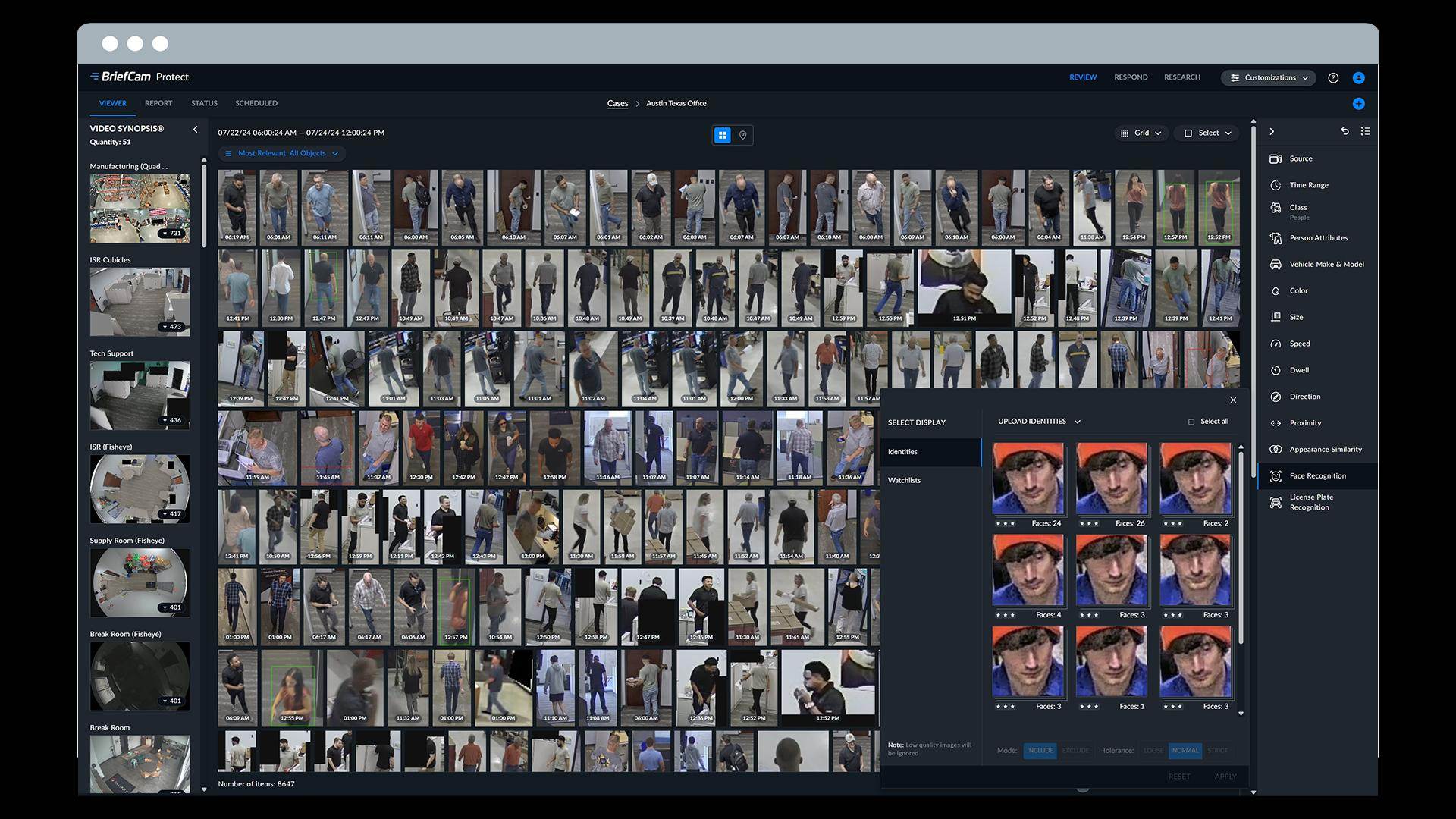
The Review module helps campus teams quickly understand what happened when an incident occurs. Instead of manually reviewing hours of footage, teams can search video using parameters like time, location and visible characteristics to isolate relevant activity across multiple cameras.
In Review, you can use Video Synopsis to condense hours of video into minutes by displaying events from different times in a single view while preserving timestamps. This makes it easier to track movement, confirm details and reconstruct events to support faster collaboration, clearer communication and confident decision-making when time matters.
Respond: Maintain real-time awareness across campus
Respond supports real-time situational awareness using intelligent, rule-based alerts. Campus teams can configure these alerts for activity such as movement in restricted areas, crowding in public spaces or unusual behavior during events.
Rather than relying on constant live monitoring, teams are notified when conditions require attention. This allows security and operations staff to assess situations as they develop, coordinate response and intervene early, reducing the risk of issues escalating unnoticed.
Research: Plan with confidence
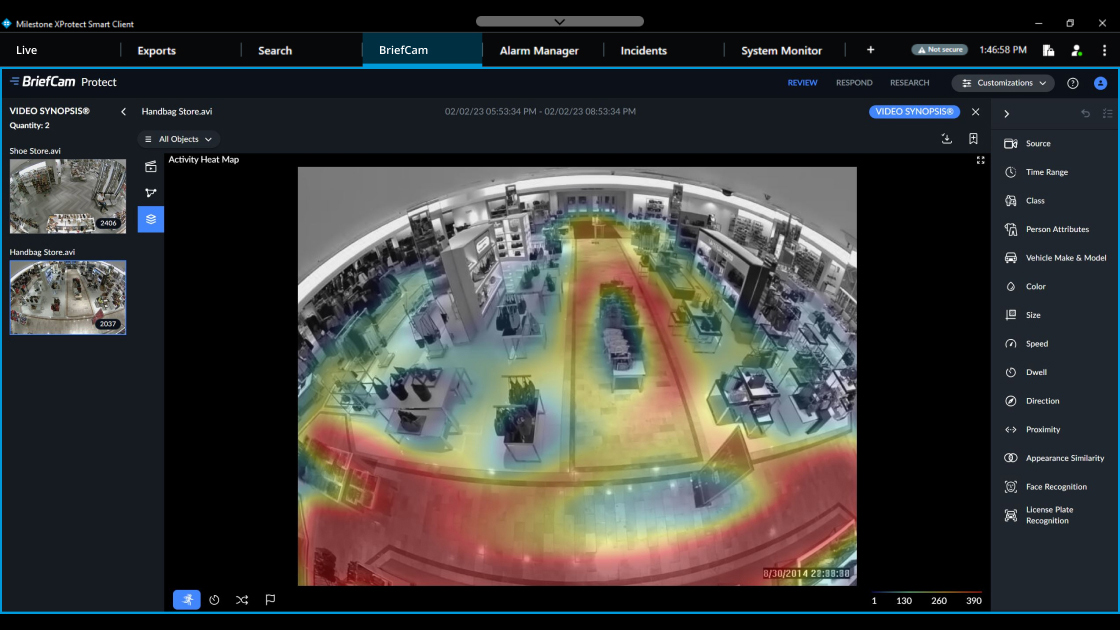
The Research module transforms everyday video into insight that supports long-term campus planning. By analyzing trends such as movement patterns, dwell time and occupancy, teams gain visibility into how students, staff and visitors use campus spaces.
These insights help universities evaluate space utilization, pedestrian flow and peak usage across buildings and outdoor areas. With both ready-made and customizable dashboards, Research converts video into data for informed decisions that improve efficiency, safety and the overall campus experience.
Using Research, campuses can track crowd levels over time to understand peak usage and plan safer, more efficient spaces.
Every campus has unique operational requirements. BriefCam offers multiple platform editions to support different scales and priorities.
Smaller campuses that primarily focus on post-incident investigation most often choose Investigator or Rapid Review. Larger, multi-campus environments often need advanced analytics as well as real-time awareness and long-term planning. This more complex deployment would benefit from Protect or Insights.
Not sure which edition fits your campus? Contact us, and our team will guide you through the options that will help you meet your goals.
The following use cases, ranging from security-focused and security-adjacent to operational, reflect real-world scenarios we commonly see with our higher education customers.
1. Accelerating campus investigation and collaboration
When an incident occurs on campus, the first priority is quickly understanding what happened and coordinating the right response. While campus security is not directly connected to municipal law enforcement, collaboration is often essential. In one instance, local police were pursuing a motorcycle suspect who passed through university grounds before evading officers. After hearing the call over the radio, the campus security manager was prepared when police requested assistance.
By confirming the timeframe of the suspect’s last known sighting, the security manager quickly retrieved approximately 15 minutes of relevant footage from four different cameras. Using Review, the team determined the suspect’s last known location was near an on-campus lake.
When law enforcement arrived, they encountered a motorcyclist in the area but initially ruled him out because he was not wearing a shirt and did not match the suspect’s description. The head of security returned to the video to gather additional details and identified a snapshot showing the suspect wearing a baseball hat. That detail proved critical—the hat matched one found tucked under the seat of the motorcycle. Armed with this visual confirmation, officers were able to immediately apprehend the suspect.
2. Reuniting individuals quickly during crowded campus events
On large campuses and during crowded events, it’s easy for people to become separated from their group. When that happens, speed matters—especially when children or vulnerable individuals are involved.
During a busy sporting event, a child was reported missing on campus. The security team immediately began searching footage using Review, filtering based on the clothing description and last known location provided by the child’s guardian. Rather than relying on eyewitness accounts or manually scanning hours of video, the team was able to quickly narrow the search to the most relevant details across multiple cameras. This made it possible to quickly understand where and when the child appeared and determine their likely path.
Within a short period of time, the child was located and safely reunited with their family, reinforcing trust and demonstrating the campus’s ability to respond quickly and calmly in high-pressure situations.
By filtering video based on visible characteristics and time, campus teams can quickly narrow search efforts and reconstruct movement across crowded environments.
3. Managing access to restricted or sensitive campus areas
Higher education campuses often manage temporary or permanent restricted zones—from construction areas and service corridors to buildings with limited access during events or after hours. These situations may not start as security incidents, but they still require visibility to prevent safety risks, policy violations or disruptions to campus activity.
With Respond, teams can set alerts for activity in restricted zones, allowing them to assess situations as they occur instead of discovering issues after the fact. This reduces the need for constant manual monitoring while keeping attention where it matters most. When follow-up is needed, Review enables teams to quickly examine relevant footage for clarity and context for next steps.
By supporting visibility during periods of change or increased activity, BriefCam helps campuses maintain safer environments and reduce the likelihood of issues escalating into larger concerns.
4. Improving pedestrian safety and micro-mobility planning
Scooters, bikes and other micro-mobility devices are now part of everyday campus life. While they help students and staff move quickly across large environments, they also introduce safety challenges in shared spaces like walkways, plazas and retail areas.
To move beyond anecdotal complaints and isolated incidents, one university took a data-driven approach to understand how micro-mobility devices were actually being used across campus. Using BriefCam Review, the team processed video from targeted locations and applied movement-based filters: adjusting speed thresholds to surface activity moving at approximately 8–9 mph. This effectively isolated scooters, skateboards and similar devices while eliminating most pedestrian traffic, without requiring hours of manual review.
Then, using Research, the university analyzed this filtered data over time using heatmaps and trend reports to identify where micro-mobility devices and pedestrians most frequently intersected, when congestion peaked and which areas consistently posed higher risk.
These insights informed practical changes to pathways, signage and campus guidance. Rather than restricting mobility, the university improved safety for both riders and pedestrians by making planning decisions grounded in real behavior observed on campus.
Research dashboards combine heatmaps and trend data to help campuses understand where micro-mobility and pedestrian traffic intersect and plan safer shared spaces.
5. Managing occupancy and space usage across campus
Understanding how campus spaces are used day-to-day is as important as responding to incidents. Lecture halls, libraries, gyms and student centers all experience fluctuating demand, and assumptions or static schedules often lead to inefficiencies.
With BriefCam, campuses can use video analytics to understand movement and occupancy over time. Using the Research module, teams analyze trends such as entry and exit activity, dwell time and peak usage across buildings and zones.
These insights help operations and facilities teams identify overcrowded or underutilized spaces and plan staffing, cleaning and maintenance schedules based on real usage patterns. When questions arise around specific events or timeframes, Review can also be used to quickly validate activity and provide additional context.
By turning everyday video into operational insight, campuses can improve efficiency, support safety requirements and create more comfortable environments for students and staff.
These insights informed practical changes to pathways, signage and campus guidance. Rather than restricting mobility, the university improved safety for both riders and pedestrians by making planning decisions grounded in real behavior observed on campus.
Occupancy analysis in Research helps facilities teams identify peak usage periods and underutilized spaces across campus buildings.
Managing safety and operations on a higher education campus is complex. Every day brings new variables, from crowded events and changing mobility patterns to the ongoing challenge of making the most of limited resources.
With BriefCam, campuses can move beyond simply reacting to incidents and start using video as a source of understanding. Investigations become faster and more focused. Situational awareness improves when it matters most. Over time, patterns emerge that help teams plan better, allocate resources more effectively and reduce risk before issues escalate.
The result isn’t just improved security or smoother operations. It’s confidence. Confidence that you can respond quickly when something happens, learn from what you see and make informed decisions that support the safety and experience of everyone on campus.
If you’re ready to see how you can support your campus goals with BriefCam, book a demo to explore how video analytics can work for you.